A commercial property rarely becomes dirty all at once.
It happens slowly. A few dark marks near the entrance. Gum pressed into the walkway. Grease is spreading beyond the service area. Tire residue around a loading dock. Green growth appears on the shaded side of the building.
Because the change is gradual, it often goes unnoticed until the exterior looks tired or a surface becomes difficult to clean.
That is why commercial pressure washing services are more useful as part of a routine maintenance plan. The purpose is not to keep every surface looking brand new. It is to prevent ordinary dirt and operational mess from developing into a larger problem.
For property managers, restaurant operators, and facility teams, planned exterior cleaning also removes some of the guesswork. The work can be timed around traffic, deliveries, tenant access, weather, and seasonal maintenance instead of being arranged urgently after a complaint.
Key Takeaways
- Commercial properties collect dirt gradually, so exterior buildup is often missed until it becomes harder and more expensive to remove.
- Routine pressure washing helps prevent grease, gum, salt, algae, oil, stains, and traffic residue from turning into larger maintenance issues.
- Different areas need different cleaning schedules. Entrances, walkways, loading docks, garbage enclosures, patios, and exterior walls do not get dirty at the same speed.
- Waiting too long can make cleaning more disruptive, especially when entrances, service lanes, loading areas, or grease-prone zones need extra treatment.
- Pressure washing can help reduce buildup that contributes to slippery surfaces, but it should be planned alongside proper drainage, repairs, and winter maintenance.
- Commercial pressure washing should be scheduled around business operations, including customer traffic, deliveries, tenant access, and seasonal conditions.
- Pressure Kleen can build routine exterior cleaning programs around the way each property is actually used, instead of treating every surface the same.
The Practical Case for Routine Exterior Cleaning
Most commercial sites have areas that become dirty much faster than others.
A front walkway may see hundreds of footsteps each day. A restaurant’s rear service area may collect grease, food residue, and leaking waste. A loading zone can pick up rubber marks, pallet debris, dust, and vehicle fluids. Even a quiet office property will accumulate soil, pollen, runoff stains, and winter grime.
None of this is unusual. It is simply part of operating a building.
The problem begins when cleaning is delayed until the buildup becomes severe. At that point, stains may have settled into porous concrete, gum may be harder to lift, and greasy areas may require more treatment than they would have several months earlier.
Routine cleaning breaks that cycle. It deals with the dirt while it is still manageable.
It also allows property staff to see what is happening underneath. Once a surface is cleaned, recurring leaks, drainage issues, damaged joints, failing coatings, and repeated spill patterns are easier to spot.
What Builds Up Around Commercial Properties
Exterior grime is rarely just “dirt.”
On a working commercial site, it may include:
- oil and vehicle residue;
- grease from kitchens or waste areas;
- chewing gum;
- spilled drinks;
- food waste;
- salt and winter road film;
- algae and organic growth;
- dust from traffic or construction;
- soot and atmospheric residue;
- leaf staining, pollen, and sap;
- rust marks or runoff staining.
The source often tells you how frequently an area should be cleaned.
A shaded walkway that stays damp may need attention because of organic growth. A busy restaurant entrance may need more frequent commercial pressure cleaning because of foot traffic and spills. A loading dock may remain acceptable for months, then deteriorate quickly during a busy shipping period.
This is why one fixed schedule for the entire property rarely works well.
Areas That Usually Need the Most Attention
Some exterior surfaces can go a long time between washes. Others show wear quickly.
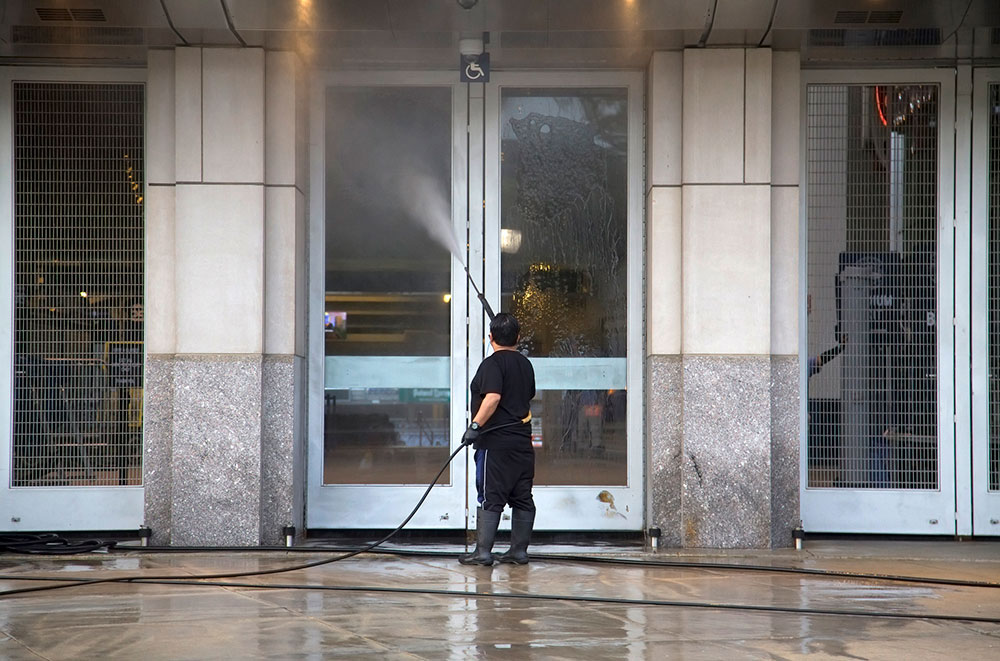
Entrances and front walkways
These are the first areas customers, tenants, and visitors see. They also collect the most foot traffic, which means dirt is repeatedly ground into the surface.
Small spills and gum tend to stand out here because people are moving slowly, waiting near doors, or looking down as they enter.
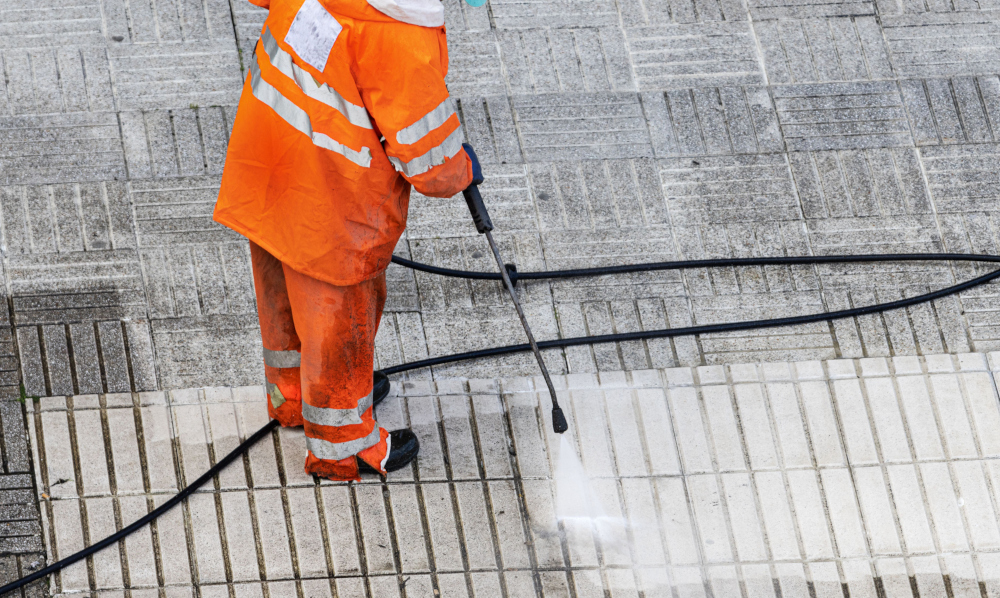
Sidewalks and pedestrian routes
Walkways can become uneven in appearance, especially where some sections receive full sun and others remain shaded. Dirt, organic matter, and moisture often collect along edges, near curbs, and around planters.
Restaurant service areas
These areas can change quickly. Grease, food residue, waste liquids, and delivery traffic all contribute to the condition of the surface.
They may not be visible to customers, but they still affect staff safety, odour control, sanitation, and the overall upkeep of the property.
Garbage enclosures and dumpster pads
Waste areas are among the hardest-working parts of a commercial site. Leaking bags, bin residue, spilled liquids, and vehicle traffic can leave the concrete stained and unpleasant.
The ground around the enclosure matters as much as the bins themselves.
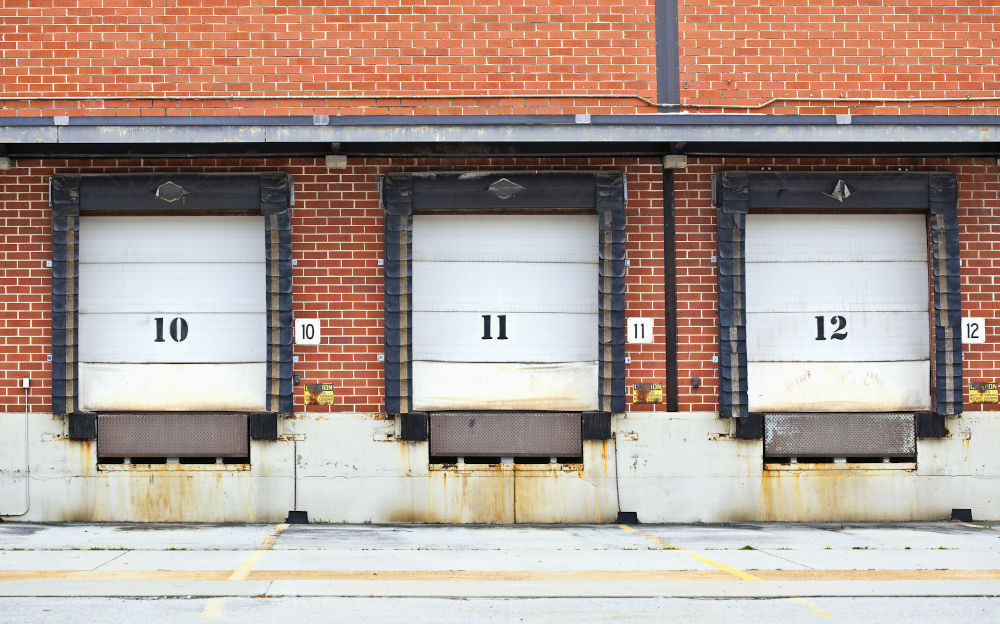
Loading docks and delivery lanes
Dust, rubber marks, damaged packaging, oil, and general grime build up in these areas. Cleaning must usually be planned around delivery times because access cannot simply be blocked without notice.
Parking areas and drive-through lanes
These surfaces collect oil, tire residue, salt, mud, and litter. Drive-through lanes may also have drink spills and food waste, particularly near order and pickup points.
Exterior walls
Building power washing is often needed where walls develop streaking, airborne dirt, algae, or discolouration beneath rooflines and drainage points.
The method needs to suit the actual cladding. A concrete wall, painted surface, brick façade, and metal panel system should not all be treated the same way.
Why Waiting Too Long Costs More
A heavily stained surface usually takes more work than one cleaned on a reasonable schedule.
That does not necessarily mean every old stain can be removed completely. Some oils penetrate deeply. Rust may react with the surface. Organic growth can leave discolouration behind. Weathering may also make one section look different from another, even after cleaning.
Still, fresh buildup is generally easier to deal with than residue that has been sitting through months of traffic, heat, cold, and moisture.
There is another cost to delay: disruption.
A neglected entrance may require a larger work area to be closed. A badly soiled service lane may take longer to clean and dry. A grease-heavy zone may need additional treatment and runoff control. That can interfere with deliveries, staff access, or customer movement.
Routine service usually makes the job more predictable.
Exterior Cleaning and Slip Concerns
Pressure washing does not replace proper inspections, repairs, drainage, or winter maintenance. It can, however, remove materials that make exterior areas more difficult to use safely.
Grease near a kitchen exit is an obvious example. So is algae on a shaded ramp. Food residue, spilled drinks, waste liquids, and wet organic matter may also create slick patches.
The concern is not limited to customers. Employees, delivery drivers, contractors, and maintenance staff may use side routes and service areas that receive less day-to-day attention than the front entrance.
Scheduled cleaning gives these areas a better chance of being dealt with before someone reports a problem.
The work itself must also be planned properly. Hoses, standing water, wet pavement, and temporary closures can create their own hazards if the site is not controlled.
That is one reason commercial work should be timed carefully rather than treated like a quick residential wash.
Cleaning Around an Active Business
A commercial property cannot always stop operating for cleaning.
Restaurants still receive deliveries. Retail plazas have customers coming and going. Industrial sites may run multiple shifts. Offices may have tenants entering early and leaving late.
The schedule has to fit the building.
In practice, that may mean working early in the morning, overnight, during a quiet weekday, or in sections so the entire area is not closed at once.
Access points also matter. A front entrance may need to remain open while a side walkway is cleaned. A loading dock may have a narrow window between delivery runs. A garbage area may need to be serviced after pickup but before new waste begins accumulating.
These details are not minor. They often determine whether a cleaning program works smoothly or becomes a nuisance to everyone using the site.
Routine Pressure Washing Programs: What They May Include
A routine program does not have to cover the whole property on every visit.
In many cases, it makes more sense to divide the site by use.
High-traffic areas can be cleaned often. Lower-use surfaces can remain on a seasonal or annual cycle. Grease-prone spaces may have their own schedule.
A restaurant property, for example, may need:
- frequent cleaning near rear exits and waste areas;
- periodic washing of the main entrance and patio;
- seasonal work on walkways;
- less frequent cleaning of exterior walls.
A retail plaza may place more emphasis on storefront paths, gum removal, curbs, loading areas, and shared waste enclosures.
An industrial facility may focus on loading docks, traffic lanes, employee entrances, equipment approaches, and selected wall surfaces.
The best schedule follows how the property actually operates.
How Often Should Commercial Exterior Surfaces Be Cleaned?
There is no useful one-size-fits-all answer.
A busy entrance may need monthly attention. A quieter walkway may only need cleaning once or twice a year. A restaurant grease area might require frequent service, while an exterior wall may remain acceptable for much longer.
Several factors affect frequency:
- customer and employee traffic;
- food service activity;
- vehicle movement;
- shade and moisture;
- nearby trees and landscaping;
- winter salt exposure;
- type of surface;
- drainage;
- surrounding construction;
- the standard expected by the owner or tenants.
The first schedule is usually an estimate. After several visits, it becomes easier to see which areas soil quickly and which do not need as much attention.
That adjustment matters. Overcleaning wastes money. Under-cleaning simply returns the property to reactive maintenance.
Exterior Pressure Washing Maintenance Table
| Area | Common Issue | Why It Matters | General Frequency |
|---|---|---|---|
| Main entrance | Gum, spills, dirt, shoe marks | First impression and pedestrian use | Monthly to quarterly |
| Walkways | Organic growth, soil, food residue | Appearance and slip concerns | Quarterly or seasonally |
| Restaurant service area | Grease, waste residue, spills | Staff safety, odour, sanitation | Monthly or more often |
| Garbage enclosure | Leaking waste, grime, liquids | Odour, pests, overall site condition | Monthly to quarterly |
| Loading dock | Tire marks, debris, oil, dust | Operational upkeep and safer access | Quarterly or based on activity |
| Parking surfaces | Oil, salt, tire residue, mud | Appearance and surface maintenance | Seasonally or annually |
| Exterior walls | Streaks, algae, dust, runoff | Building presentation and surface care | Annually or as needed |
| Patio | Food spills, dirt, organic growth | Guest experience and active use | Monthly during open season |
These are starting points, not fixed rules.
Why Equipment and Technique Matter
More pressure does not automatically mean a better result.
High pressure can damage weak mortar, scar concrete, lift paint, force water into joints, or disturb seals around doors and windows. On the other hand, insufficient cleaning power may leave grease and embedded dirt behind.
The operator has to match the method to the surface and the contamination.
Hot water may help with oily residue. A surface cleaner can provide a more even finish across large concrete sections. Lower pressure may be needed on painted walls, siding, signage, or older masonry.
Detergent selection matters as well. A product suitable for grease may not be appropriate for every wall finish or landscaped area.
Drainage is another part of the job. Water may travel toward storm drains, neighbouring units, parked cars, entrances, or planted areas. On a commercial property, that movement has to be anticipated.
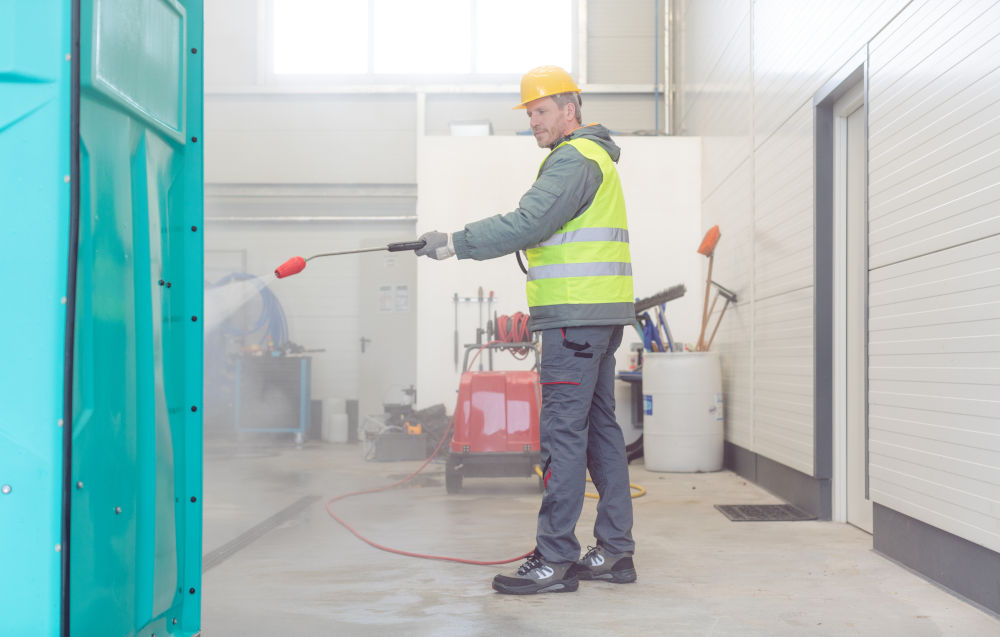
Professional commercial pressure washing services involve far more than pointing a wand at the ground.
Curb Appeal Still Matters
Exterior cleaning is practical, but appearance remains important.
Customers notice dirty entrances. Prospective tenants notice stained walkways. Inspectors notice neglected service areas. Staff also respond to the condition of the place where they work.
A maintained property does not have to look flawless. It should look cared for.
Routine cleaning helps avoid the sharp decline that occurs when grime builds up for a long period and is only addressed after it becomes embarrassing.
It also creates consistency across shared properties. In a retail plaza or multi-tenant building, one badly maintained common area can affect the presentation of every business around it.
How Pressure Kleen Approaches Routine Maintenance
Pressure Kleen works with businesses, restaurants, commercial properties, and industrial facilities that need exterior cleaning planned around real operating conditions.
The starting point is the site itself: what surfaces are present, where buildup occurs, how people move through the property, where water drains, and when the work can be completed with the least interruption.
Some areas may require regular commercial pressure cleaning. Others may only need seasonal attention. A full-property wash is not always necessary on every visit.
Pressure Kleen can structure service around entrances, walkways, loading docks, garbage areas, parking surfaces, exterior walls, and other high-use zones.
The aim is to keep maintenance steady and manageable rather than wait for the property to reach the point where a large cleanup becomes unavoidable.
Build Exterior Washing Into the Property Plan
Commercial pressure washing services are easier to manage when they are planned in advance.
A regular program gives property managers more control over cost, scheduling, access, and surface condition. It helps prevent grease, gum, stains, organic growth, and traffic residue from building up unchecked.
It can also reveal recurring maintenance issues that dirt would otherwise hide.
The right schedule will not be identical for every building. It should reflect how the site is used, which areas become dirty fastest, and how much disruption the business can reasonably accommodate.
Pressure Kleen can help establish a practical service plan for commercial and industrial properties without turning routine cleaning into an oversized project.
Frequently Asked Questions
Do commercial properties need routine exterior pressure washing?
Most do, although the frequency varies. Properties with heavy foot traffic, food service, vehicle activity, shaded walkways, or shared waste areas usually need more regular cleaning than low-traffic sites.
What areas can be included in a commercial pressure washing program?
A program may include entrances, sidewalks, loading docks, patios, garbage enclosures, parking surfaces, drive-through lanes, exterior walls, service routes, and grease-prone areas.
How often should commercial walkways be cleaned?
Busy walkways may need monthly or quarterly service. Lower-traffic areas may only need seasonal cleaning. Moisture, shade, winter salt, food spills, and nearby landscaping can shorten the interval.
Can pressure washing help with slippery surfaces?
It can remove grease, algae, food residue, and other buildup that may contribute to slippery conditions. Damaged surfaces, drainage problems, ice, and structural defects still require separate attention.
Is building power washing safe for all exterior materials?
Not with the same equipment settings. Pressure, water temperature, detergents, and technique should be adjusted for concrete, brick, painted surfaces, metal panels, siding, and older masonry.
Should exterior washing only be scheduled after winter?
No. Winter residue is one reason to clean, but properties collect grease, gum, spills, vehicle residue, pollen, dirt, and organic growth throughout the year.
What is included in commercial pressure washing services?
The scope may include site review, surface assessment, cleaning of agreed areas, stain treatment where appropriate, work-zone control, water management, and scheduling around business operations.
How can property managers set up a routine program?
A site review is usually the best starting point. The property can then be divided into high-, medium-, and low-frequency areas, with cleaning dates arranged around traffic, deliveries, tenants, and seasonal conditions.