Hood filters are the only part of a commercial kitchen exhaust system that most staff handle directly, and the part most often dealt with at speed at the end of a shift. They are also governed by more specific requirements than most operators realise.
NFPA 96 sets out what a grease filter must be made of, how rigid it must be, how it must be angled, how far it must sit above the cooking surface and how it must be arranged in the bank. A rinse under a tap addresses none of those things, and a filter that has been crushed in a dishwasher rack fails one of them outright.
This matters beyond the filters themselves. They are the first mechanical stage in a path that continues through the plenum, the grease ducts and the exhaust fan, so filter condition determines how much grease reaches the parts nobody can see. Understood properly, filter maintenance is the daily half of restaurant hood cleaning, with professional service covering the rest.
Key Takeaways
- NFPA 96 sets construction and installation requirements for grease filters, not just cleaning expectations: steel or listed equivalent material, rigid enough not to deform under handling and cleaning, and arranged so all exhaust air passes through the bank.
- Removable filters that are not integral to a listed hood must be listed to UL 1046, or CAN/ULC-S649 in Canada. The practical check is a UL or ETL mark stamped into the frame.
- Standalone mesh filters are not permitted unless evaluated as part of a listed hood or listed alongside a primary filter, because mesh offers a comparatively open path for both grease and flame.
- Filters must sit at not less than 45 degrees from horizontal and at least 18 in (457 mm) above the cooking surface, reduced to 6 in (152 mm) only where there is no exposed flame. Angle is what makes drainage work; a flat or bent filter is what produces dripping.
- Cleaning has a measurable endpoint rather than a visual one: a depth gauge reading of 0.078 in (2000 μm) triggers cleaning, and surfaces are cleaned to a remaining minimum of 0.002 in (50 μm).
- The standard’s schedule is an inspection schedule with a cleaning trigger attached, ranging from monthly for solid fuel to annually for low-volume operations. Filters themselves need attention far more often, commonly daily in high-volume kitchens.
- Clean filters establish the condition of the filters only. The plenum, grease ducts, fan and rooftop can hold substantial deposits while the filter face looks acceptable.
What NFPA 96 Requires of Grease Filters
NFPA 96 treats filters as grease removal devices with defined construction, listing and installation requirements. The following summarises the provisions most relevant to day-to-day operation.
| Requirement | What the standard sets out | Why it matters in practice |
|---|---|---|
| Listed devices | Listed grease filters, baffles or other listed grease removal devices must be provided (NFPA 96, 6.1.1) | Unlisted or improvised filters are not acceptable regardless of how clean they look |
| Listing standard | Removable devices that are not integral to a listed hood must be listed to UL 1046, or CAN/ULC-S649 in Canada (6.1.2, 6.1.3) | A UL or ETL stamp on the frame is the practical check |
| Mesh restriction | Standalone mesh filters are not permitted unless integral to a listed hood or listed with a primary filter (6.1.3) | Many older kitchens still run mesh that would not pass review |
| Material | Steel or listed equivalent material (6.2.3.1) | Aluminium units are not a compliant substitute |
| Construction | Rigid enough not to deform under normal use, handling or cleaning (6.2.3.2) | A filter crushed in a sink or dishwasher rack is no longer performing |
| Coverage | Arranged so all exhaust air passes through the filters (6.2.3.3) | A gap or missing filter defeats the whole bank |
| Access | Easily accessible and removable for cleaning (6.2.3.4) | If filters are awkward to pull, they will not be cleaned often enough |
| Angle | Installed at not less than 45 degrees from horizontal (6.2.3.5) | Angle is what makes drainage work |
| Separation | Not less than 18 in (457 mm) above the cooking surface, reduced to 6 in (152 mm) where there is no exposed flame and flue gases bypass the device (6.2.1.1, 6.2.1.3) | Distance affects both fire exposure and grease loading rate |
Section numbering shifts between editions of the standard. The grease removal requirements sit at 6.1 and 6.2.3 in current published references; the inspection schedule appears as Table 11.4 in older editions and Table 12.4 in recent ones. When citing a clause to an inspector, cite the edition adopted locally.
Which Filters Are Actually Permitted?
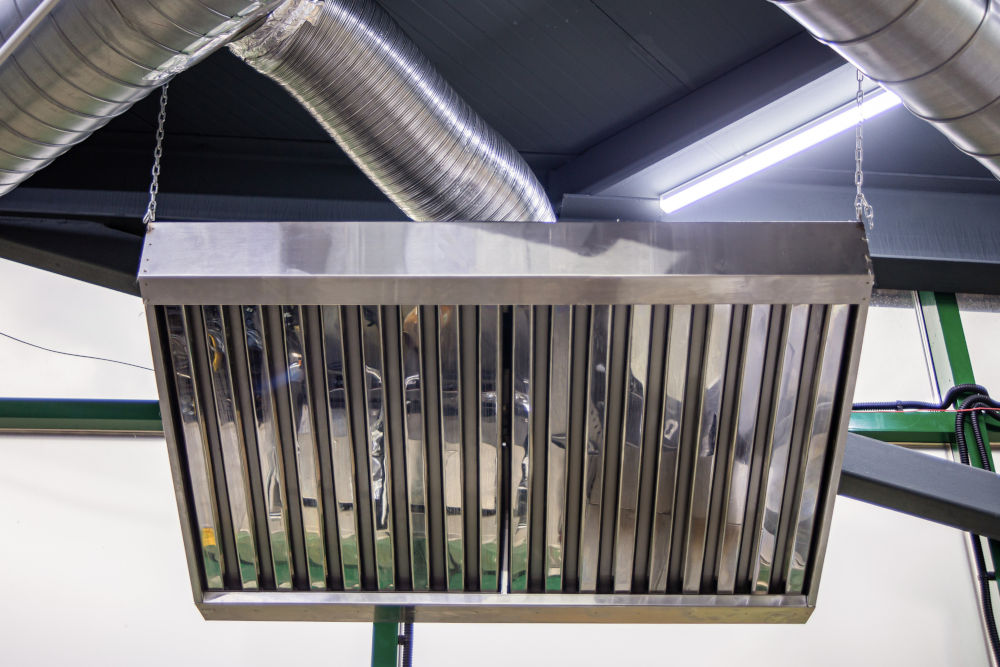
Listed baffle filters are the default acceptable option, and standalone mesh filters are not permitted unless they are evaluated as an integral part of a listed hood or listed together with a primary filter.
The reasoning is mechanical rather than arbitrary. A baffle forces the exhaust stream through abrupt changes of direction, so grease droplets cannot follow the turn and strike the metal instead. That same geometry obstructs flame travel. Mesh, by contrast, offers a comparatively open path, which is why it is restricted to assemblies where it has been evaluated as part of a tested design.
The listing route is UL 1046, or CAN/ULC-S649 for Canadian installations. In practice the check is physical: a compliant unit carries a UL or ETL mark stamped into the frame. A filter with no mark is worth raising with a service provider rather than assuming it is acceptable.
Material is specified as steel or a listed equivalent, which rules out aluminium units that occasionally appear as cheap replacements. Aluminium also corrodes quickly in the alkaline detergent used in commercial dishwashers, so it fails on durability as well as on listing.
How Does Grease Loading Restrict Airflow?
Filters work by controlling airflow, so anything that clogs them also restricts it. As grease accumulates, the open paths through the baffles narrow and the exhaust fan draws less air even though nothing about the fan has changed.
Published airflow-loss figures for specific filter models and loading states are not available in a form that can be generalised across installations, so no single percentage should be quoted. What is consistent is the pattern: the loss is gradual, it goes unnoticed week to week, and it becomes visible only as secondary symptoms. Smoke lingers under the canopy, heat builds along the cooking line, cooking smells reach the dining room, and the fan runs harder for less result.
The standard reflects this indirectly. Filters must be arranged so all exhaust air passes through them and must be easily removable for cleaning, both of which exist because the system depends on filters being cleaned frequently and seated correctly.
There is also a mechanical cost. A fan working against unnecessary restriction is operating outside the conditions it was selected for, and sustained strain does not extend motor or belt life.
Why Does the Hood Stop Capturing Smoke?
Capture depends on adequate airflow across the whole face of the hood, not just the centre, so uneven filter loading produces uneven capture.
Loading is almost never uniform. Filters above a fryer or charbroiler saturate considerably faster than those above a range, which means one section of the bank restricts while another still flows. Air takes the easier route, the loaded section stops pulling, and the plume escapes at the edges of the canopy.
A missing or badly fitted filter creates the opposite failure and a worse one. The gap becomes a low-resistance path, so exhaust air bypasses the bank instead of being drawn evenly across it, and grease travels into the plenum without being separated at all. This is precisely the condition the coverage requirement is written to prevent.
A complete, correctly sized, correctly seated filter bank is therefore a baseline condition for effective commercial hood cleaning, not a detail to be settled afterwards.
What Causes Dripping Grease and Odour?
Dripping is a drainage failure, not simply a sign of dirt. Filters are required to be installed at not less than 45 degrees from horizontal because that angle is what moves separated grease into the drain channels and collection cup.
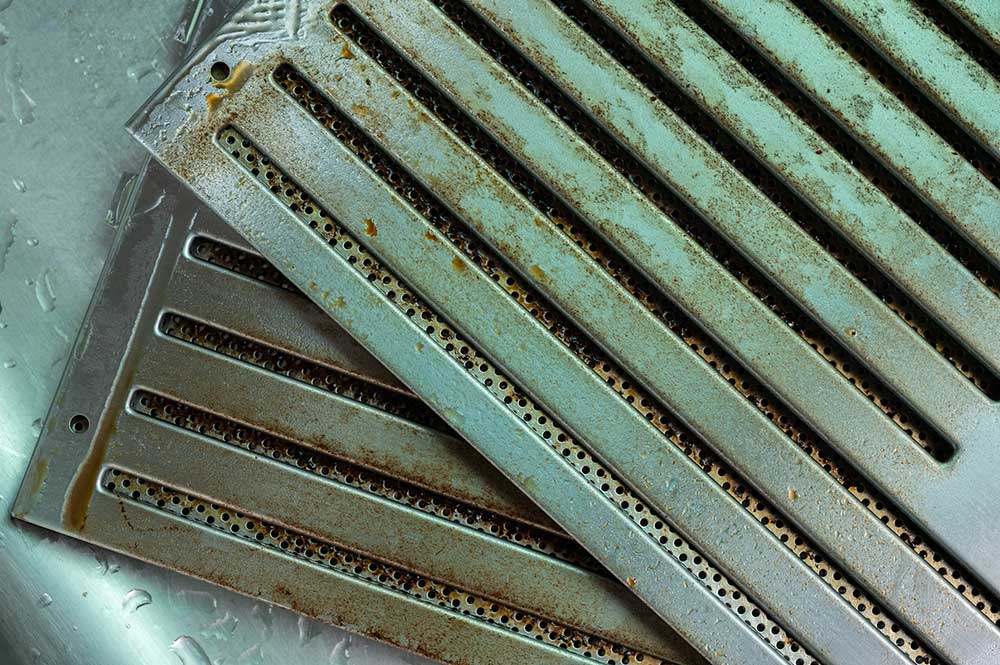
When channels are blocked with hardened residue, when the cup has not been emptied, or when a filter has been bent or seated flat, the grease has nowhere to go and runs down the filter face onto the appliances below. That is a food-safety issue and a slip hazard, and it is also a reliable indication that the filter has been in service well past the point of usefulness.
Odour follows a related mechanism. Retained grease oxidises and holds the character of everything cooked through it, while reduced airflow means less of the cooking air is actually leaving the space. Where a kitchen has persistent smells that surface cleaning does not resolve, the filter bank and the plenum behind it are the first places to examine.
How Should Hood Filters Be Cleaned?
Effective cleaning means removal, a hot degreaser soak with enough contact time to break down hardened deposits, scrubbing, a thorough rinse and full drying before refitting. A rinse under a tap does not clear residue from inside baffle channels.
Frequency is driven by grease production rather than habit. Filters need attention far more often than the rest of the system, and high-volume kitchens running fryers or charbroilers commonly handle them daily. The professional inspection interval behind that daily routine is set by cooking type: monthly for solid fuel, quarterly for high-volume operations such as 24-hour cooking, charbroiling and wok cooking, semiannually for moderate volume and annually for low-volume operations such as seasonal or institutional kitchens.
Two practical constraints are worth stating plainly. Filters must remain rigid through handling and cleaning, so a unit deformed by being forced into a dishwasher rack should be replaced rather than refitted. And where a dishwasher is used at all, it suits stainless baffle units at high temperature, loaded so water reaches into every channel; aluminium does not survive the detergent.
Noteworthy Details Worth Knowing
Four points from the standard come up repeatedly on site and are rarely known in the kitchen.
First, cleaning has a defined endpoint rather than a visual one. Recent editions require surfaces to be cleaned to a minimum of 0.002 in (50 μm) of remaining contaminant, which is what “cleaned to bare metal” means in measurable terms.
Second, there is a measured trigger for cleaning. A grease depth gauge comb is placed on the surface, and a measured depth of 0.078 in (2000 μm) requires cleaning. This is why a competent inspection produces a measurement, not an opinion.
Third, the schedule in the standard is an inspection schedule with a cleaning trigger attached, not a fixed cleaning calendar. An operator on an annual interval whose system fails the depth check needs cleaning regardless of the date.
Fourth, the separation requirement between the grease removal device and the cooking surface is 18 in (457 mm), reduced to 6 in (152 mm) only where there is no exposed flame and flue gases bypass the device. Adding an open-flame appliance under an existing hood can therefore change more than the grease load.
Alternative Perspective: Filters Are a Distraction
A reasonable counterargument holds that filter attention is oversold, because filters are cheap, replaceable and never the component that fails catastrophically. Duct and fan condition is what carries real fire risk, so effort belongs there.
That view is right about consequence. A saturated filter is not, by itself, the hazard that a heavily loaded duct run above a ceiling is, and no amount of filter care substitutes for the system service the standard requires.
It is wrong about causation. Filter condition is what governs how quickly the duct and fan load in the first place, and it is the one variable a kitchen team controls between professional visits. Filters also happen to be where compliance problems are visible without specialist access – an unmarked frame, a mesh unit, a gap in the bank. Treating them as a distraction tends to mean the duct problem is being created faster and noticed later.
If a filter feels heavy when you lift it out, capture has already dropped. Weight is a better indicator than appearance, because the face can look acceptable while the channels are full.
– Bill Doherty , President of Pressure Kleen Services Company Inc.
Check the frame stamp once and record it. Filters get replaced piecemeal over years, and that is usually how a non-compliant unit ends up in an otherwise well-run kitchen.
– Bill Doherty , President of Pressure Kleen Services Company Inc.
Filter Checks a Manager Can Run
Filters are one of the few parts of the exhaust system a manager can assess without specialist access, which makes them a useful early indicator of wider condition. The following check takes a few minutes during a walkthrough.
| Check | What to look for | What it indicates |
|---|---|---|
| Listing stamp | UL or ETL mark on the filter frame | Unmarked filters may not be compliant and should be reviewed |
| Filter type | Baffle construction rather than standalone mesh | Mesh outside a listed assembly is a compliance question, not a preference |
| Fit and coverage | No gaps at the ends of the bank, no missing units | Bypass air carries grease straight to the plenum |
| Weight | Noticeably heavy when lifted out | Saturation; capture efficiency has already fallen |
| Frame condition | Bent, crushed or distorted units | Deformed filters no longer seat or drain correctly |
| Drainage | Clear channels and an empty collection cup | Blocked drainage is what produces dripping onto the line |
| Angle | Filters seated at their intended slope, not flat | Flat or dislodged filters do not drain |
| Plenum surface | Residue on the wall behind the filters | Grease is passing the bank and loading the system |
| Perimeter capture | Smoke escaping at the edges of the canopy | Uneven loading or a restriction further along the path |
None of this replaces inspection by qualified personnel, and the standard is explicit that inspection and cleaning are carried out by trained, qualified and certified persons acceptable to the authority having jurisdiction. It does help an operator notice a developing problem before it becomes a call about smoke in the dining room.
Filters Are Only the First Stage
Clean filters establish the condition of the filters and nothing else. The plenum behind the bank, the horizontal and vertical grease ducts, the exhaust fan and the rooftop termination can hold significant deposits while the visible filter face looks acceptable.
Where filters have been poorly maintained over a long period, those hidden areas are more likely to need attention rather than less, because more grease has been allowed to travel onward.
In Ontario, Article 2.6.1.12 of the Ontario Fire Code requires cooking operations producing smoke or grease-laden vapours to have applicable exhaust and fire-protection systems in accordance with NFPA 96, and Article 2.6.1.13 requires those systems to be maintained accordingly. Filters fall inside that scope but are only one component of it.
The relationship between grease accumulation across the full exhaust route, cleaning frequency and inspection readiness is covered separately in our article on how grease buildup affects fire code compliance. Questions about how the requirements apply to a specific property should go to the local authority having jurisdiction.
How Pressure Kleen Handles Filter Service
Pressure Kleen provides commercial kitchen hood and exhaust system cleaning for restaurants, institutional kitchens, franchise operators and other commercial facilities in Ontario.
Filters are handled as part of the exhaust path rather than as a separate item. Service covers the hood and filter area, the plenum behind the bank, accessible grease ductwork, and fan and rooftop components. Where cleaning reveals a condition that needs further work – a deformed or unmarked filter, a blocked drainage channel, a damaged access panel, a duct section that cannot be reached properly – it is reported rather than left unrecorded.
The technical side is supported by PECT-designated personnel through IKECA, and further detail on that involvement is on the associations and certifications page.
The Absolute Proof® documentation programme then supplies before-and-after photographs, service reports and deficiency reporting. For a single site that gives a traceable maintenance history; for a multi-location operator it makes it possible to see whether the same standard is being applied across sites.
Filter work between visits belongs to the kitchen team. Everything the team cannot reach, measure or verify is where hood cleaning services earn their place.
Frequently Asked Questions
How often should restaurant hood filters be cleaned?
Frequency is set by grease production rather than a fixed rule. High-volume kitchens running fryers or charbroilers commonly clean filters daily, while lighter operations need it less often. The professional inspection interval behind that routine ranges from monthly for solid fuel operations to annually for low-volume kitchens.
Are mesh hood filters allowed under NFPA 96?
Standalone mesh filters are not permitted. Mesh is acceptable only where it has been evaluated as an integral part of a listed hood or listed in conjunction with a primary filter under UL 1046, or CAN/ULC-S649 in Canada.
Can hood filters be washed in a dishwasher?
Stainless baffle filters can generally be run in a high-temperature commercial dishwasher, loaded so water reaches into every channel. Aluminium units corrode in alkaline detergent, and any filter deformed by handling or by a dishwasher rack should be replaced, since the standard requires filters to stay rigid through cleaning.
How do I know if my hood filters are compliant?
Look for a UL or ETL mark stamped into the filter frame, confirm the units are baffle-type steel construction, check that the bank is complete with no gaps, and confirm the filters are seated at their intended angle of at least 45 degrees from horizontal.
Why is grease dripping from the hood filters?
Dripping indicates that separated grease cannot drain. The usual causes are hardened residue blocking the drain channels, a full collection cup, or a filter that has been bent or seated flat so the required angle is lost.
What does cleaning to bare metal actually mean?
Recent editions of the standard define it in measurable terms: surfaces are cleaned to a minimum of 0.002 in (50 μm) of remaining contaminant. Cleaning is triggered when a depth gauge comb measures 0.078 in (2000 μm) of deposit.
Do clean filters mean the exhaust system is clean?
No. Filters are the first stage only. The plenum, grease ducts, exhaust fan and rooftop area can hold substantial deposits while the filter face appears acceptable, and those areas require inspection and cleaning by qualified personnel.
Where Filter Maintenance Pays Off
Most exhaust complaints that reach a manager – smoke in the kitchen, smells in the dining room, grease on the cooking line – have a filter condition somewhere in the sequence. That is useful, because filters are also the most accessible and most inexpensive part of the system to get right.
The work is unglamorous and specific: confirm the units are listed and undeformed, keep the bank complete and correctly angled, clean properly rather than quickly, and empty the drainage. Doing that will not maintain the duct, the fan or the rooftop, and it is not meant to. It keeps the hood capturing as designed, slows how fast grease reaches the parts nobody can see, and makes the professional restaurant hood cleaning that follows considerably more straightforward.